
Novartis Pharmaceuticals Corporation
One Health Plaza
East Hanover, NJ 07936-1080
Exhibit 99.1
| |
Novartis Pharmaceuticals Corporation One Health Plaza East Hanover, NJ 07936-1080 |
Robert Stanley
Head US Legal & Global Legal Innovation
robert.stanley@novartis.com
July 31, 2026
Paul Diamond, Ph.D.
Vice President, Legal and Intellectual Property Counsel
Actinium Pharmaceuticals, Inc.
100 Park Avenue, 23rd Floor
New York, NY 10017
pdiamond@actiniumpharma.com
Dear Dr. Diamond:
I am writing on behalf of Novartis Pharmaceuticals Corporation (“Novartis”) to repeat our concerns regarding the pre-approval promotion of ATNM-400 by Actinium Pharmaceuticals, Inc. (“Actinium”). We first raised these issues with you in an August 5, 2025, letter from Elizabeth McGee, to which we have not received any response.
Actinium has now continued the highlighted conduct in multiple press releases, including but not limited to, a June 3, 2026, press release titled “Actinium Pharmaceuticals Oral Presentation at SNMMI 2026 Highlights ATNM-400 Overcoming Resistance to All Three Approved Androgen Receptor Inhibitors and Offers Flexible, Well-Tolerated Dosing in Prostate Cancer Models”1 and a April 22, 2026, press release titled “Actinium Pharmaceuticals, Inc. Announces Compelling Pan-Tumor Data for ATNM-400 Demonstrating Broad Efficacy Across Prostate, Lung, and Breast Cancer Models at the 2026 American Association of Cancer Research Annual Meeting.”2
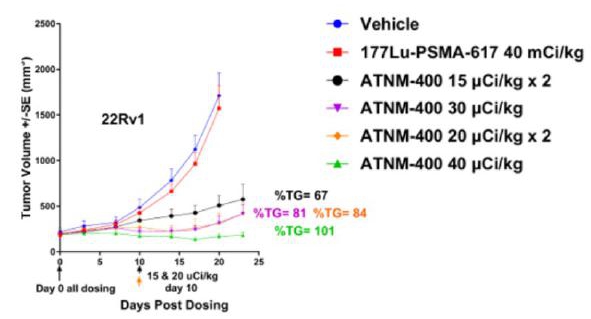
The June 2026 press release compares the efficacy of its unapproved ATNM-400 asset and Pluvicto® (lutetium Lu 177 vipivotide tetraxetan), an approved therapy that demonstrated clinical benefit in randomized trials, based solely on pre-clinical data and without substantial evidence or clinical experience. For instance, Actinium touts how its “first-in-class Actinium-225 antibody radioconjugate, targets a non-PSMA antigen linked to aggressive prostate cancer biology and delivers a high-energy alpha-particle payload that kills tumor cells through a mechanism independent of PSMA expression and androgen receptor signaling. In preclinical head-to-head studies, this PSMA-independent mechanism allowed ATNM-400 to match or exceed PSMA-targeted radioligand therapies, including 177Lu-PSMA-617 (active ingredient of Pluvicto®, Novartis) and 225Ac-PSMA-617, across PSMA-high, PSMA-low, and PSMA-negative models.” It goes on to discuss that “[i]n a low-PSMA, moderate-target tumor model (22Rv1), a single bolus dose of ATNM-400 (40 or 30 µCi/kg) delivered superior tumor control versus fractionated dosing, and a repeat 30 µCi/kg regimen sustained tumor control and survival through day 60 with all regimens outperforming 177Lu-PSMA-617 and showing minimal deviation from vehicle in blood, liver, and kidney safety markers. Flexible, well-tolerated dosing gives clinicians multiple ways to balance efficacy and safety and points to a wide therapeutic window.” The press release relies on the following graph as support:
| 1 | Actinium’s June 2026 press release can be found at https://ir.actiniumpharma.com/press-releases/detail/523/actinium-pharmaceuticals-oral-presentation-at-snmmi-2026 |
| 2 | Actinium’s April 2026 press release can be found at https://ir.actiniumpharma.com/press-releases/detail/516/actinium-pharmaceuticals-inc-announces-compelling |
| |
Letter from Novartis to Actinium July 31, 2026 Page 2 of 3 |
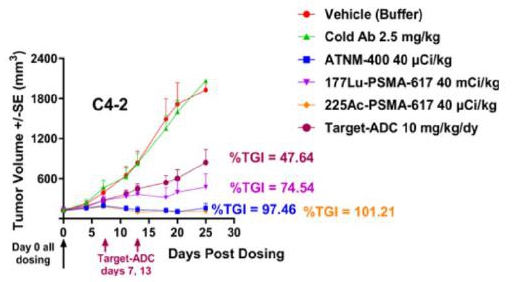
It also declares that “[i]n high PSMA expressing disease, ATNM-400 outperformed 177Lu-PSMA-617 in terms of activity and was similar to 225Ac-PSMA-617. However, as its target is not expressed in the salivary glands, ATNM-400 is not expected to cause xerostomia which is a key limitation of PSMA directed therapies.” It further goes on to detail how “[i]n a high-PSMA, high-target tumor model (C4-2), ATNM-400 matched or exceeded both PSMA-targeted radioligands-comparable to 225Ac-PSMA-617 and superior to 177Lu-PSMA-617-while being given at roughly one-thousandth the administered radioactivity of 177Lu-PSMA-617 (40 µCi/kg versus 40 mCi/kg), with durable survival and favorable tolerability. Because ATNM-400 acts independently of PSMA, this activity carries across PSMA-high, PSMA-low, and PSMA-negative models, reaching the PSMA-variable patients that PSMA-directed radioligand therapy serve least well. Moreover as the ATNM-400 target is not expressed in the salivary glands xerostomia, a limitation of PSMA directed therapies and especially PSMA-Ac-225 based agents, is not expected.” It relies on the following graph in support of this claim:
We strongly object to Actinium’s underlying data, which are based solely on hypothesis-generating preclinical models. To remedy this and other pre-approval promotional concerns, Actinium must immediately remove these pre-clinical claims.
| |
Letter from Novartis to Actinium July 31, 2026 Page 3 of 3 |
Actinium’s April 2026 press release continues comparing its investigational ATNM-400 asset, touted as a “novel, first-in-class targeted radiotherapy,” to Pluvicto® – again based solely on pre-clinical data and without the requisite clinical data. For example, Actinium proclaims ATNM-400 “[s]hows superior anti-tumor efficacy versus vehicle control, unconjugated antibody, and 177Lu–PSMA-617 (active ingredient in PLUVICTO®) in both high -PSMA, (C4-2) and low (22Rv1) PSMA-expressing models, addressing both patients unlikely to respond to PSMA-targeted radioligand therapy (low-PSMA, 22Rv1) and those who relapse on it (C4-2).” Making conclusory representations in a promotional manner regarding the safety and efficacy of a drug that has not been approved by the U.S. Food and Drug Administration and whose clinical profile has not yet been established runs afoul of U.S. law and regulation of pharmaceutical advertising and promotion. Actinium must take immediate corrective action to remove this pre-clinical claim comparing 177Lu–PSMA-617 and ATNM-400.
Along with our pre-approval promotion concerns, we also take issue with the underlying data to support this claim. In the press release, underneath this preclinical claim is a set of graphs, including two graphs related to 22Rv1 and C4- 2. Those two graphs are shown below.
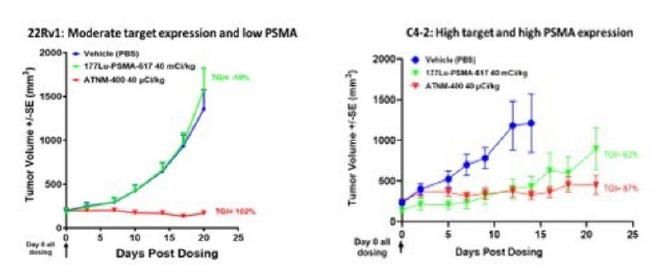
Actinium relies on an April 2026 presentation from American Association for Cancer Research (“AACR”) in support of its superiority claim.3 As with the data in Actinium’s June 2026 press release, the AACR presentation and underlying data, however, describe preclinical model findings (i.e., without clinical data). By their nature, preclinical models are hypothesis-generating and cannot be used to reliably predict clinical outcomes in humans. Accordingly, Actinium’s preclinical superiority claim is premature. Actinium must immediately remove this claim.
**************************************************************************************************************************
We request that Actinium inform us in writing within 5 business days of the immediate corrective action taken to remove relevant language, including the claims called out in our 2025 letter, from existing materials and to ensure such or similar language will not be included in any future materials. We expressly reserve the right to take further action as circumstances warrant regarding these materials or any future materials from your company.
Sincerely,
| /s/ Robert Stanley |
Robert Stanley
Head US Legal & Global Legal Innovation Novartis Pharmaceuticals Corporation
| 3 | Actinium’s AACR presentation can be found at https://d1io3yog0oux5.cloudfront.net/_27b98d591462633add8459147342ec50/actiniumpharma/db/206/1233/pdf/AAC R2026+ATNM400_PanTumor_Final+.pdf |